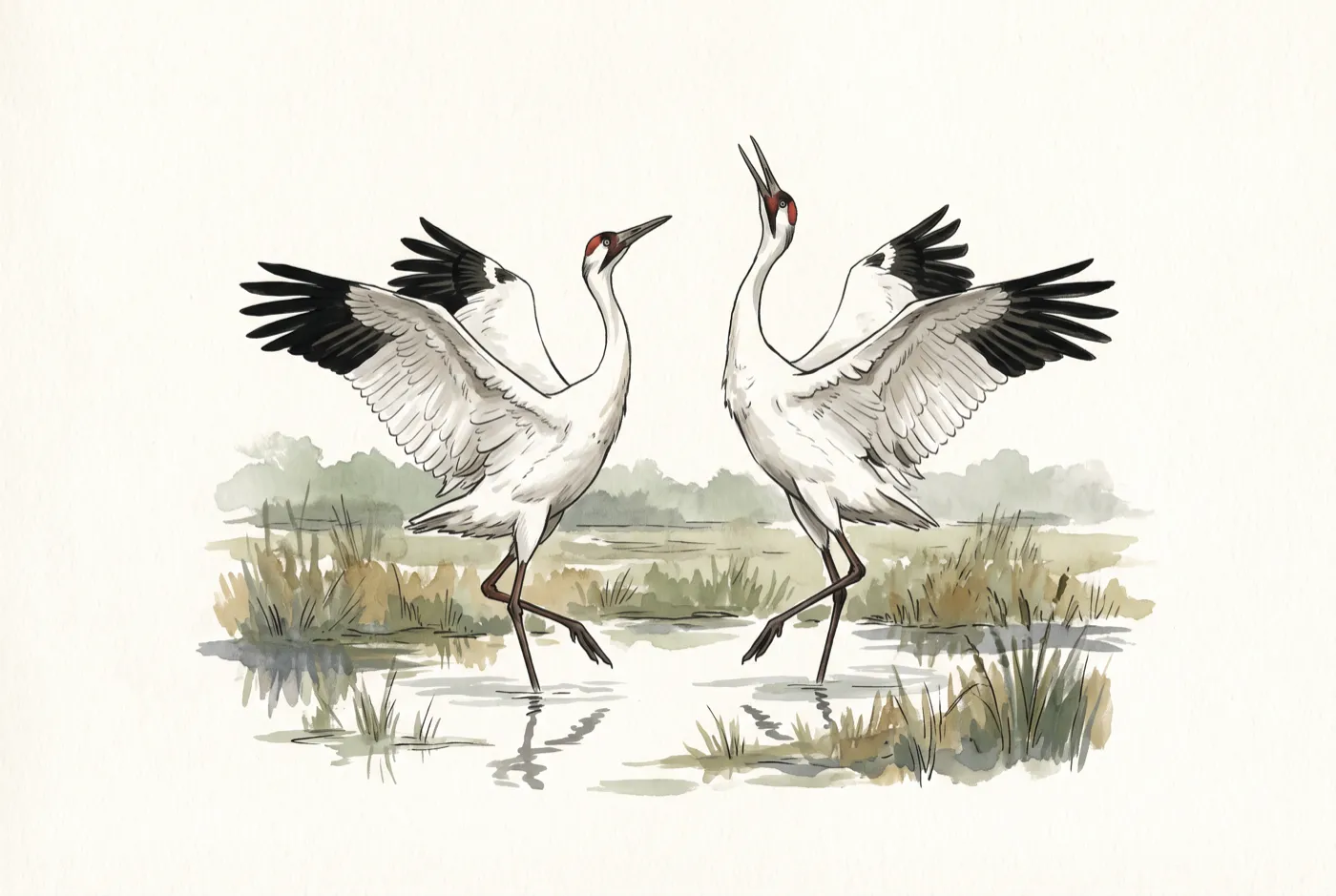
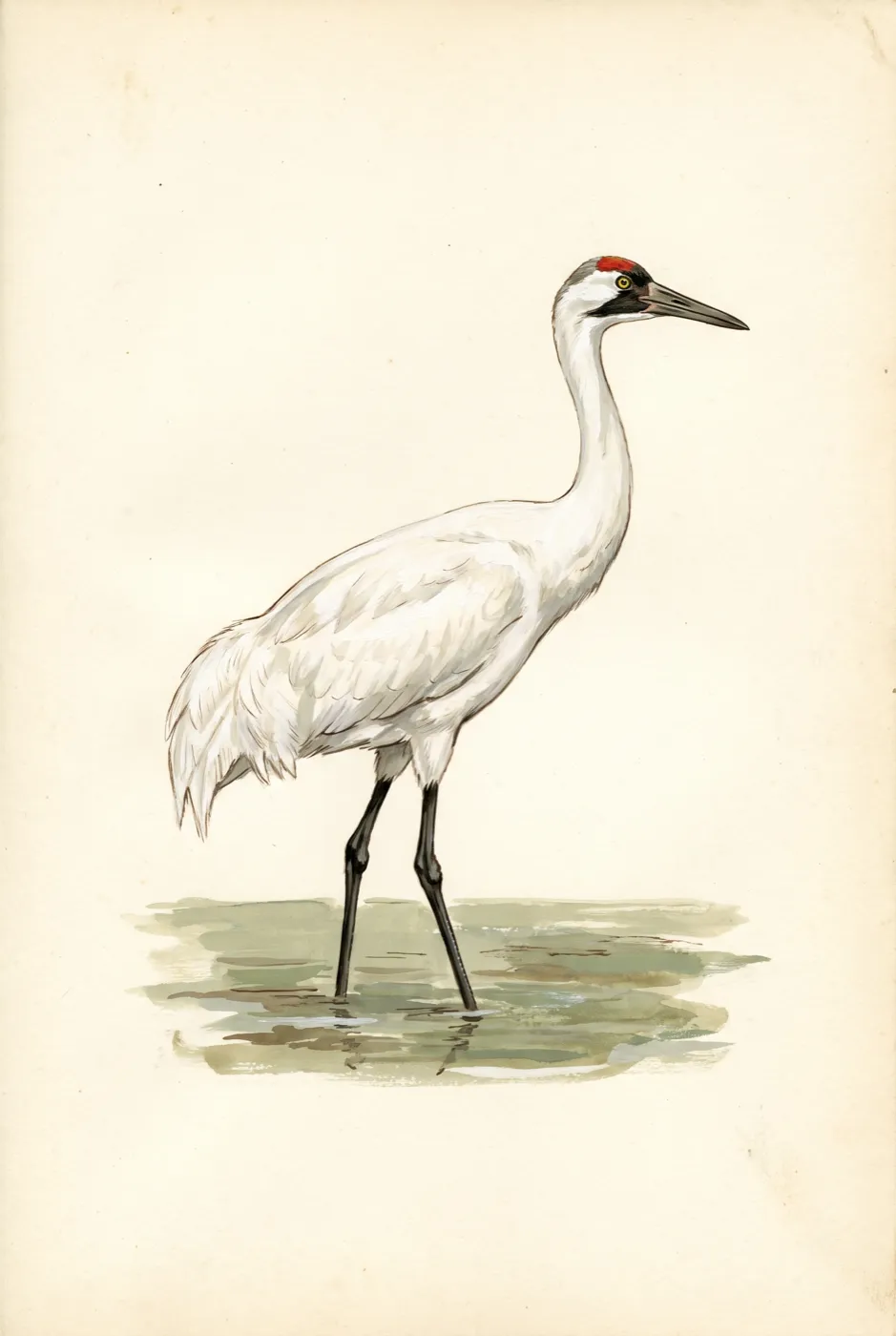
Whooping cranes learn their migration route rather than inherit it. A young crane flies its first migration alongside older birds and takes the route from them; a crane that flies it alone flies it badly. This is why rebuilding a migratory flock from captive-bred birds required someone to fly the route first, and why the knowledge a flock holds can be lost while the birds themselves are still being counted.
What the aircraft were actually for
Between 2001 and 2016, captive-reared whooping cranes in Wisconsin were led south on their first migration by a piloted ultralight aircraft. The image is strange enough that it tends to be remembered as a stunt, but the aircraft was solving a specific and narrow problem: the birds had no older cranes to follow. The route existed in no other bird's head, so a human flew it.
The programme ended in 2016. The International Crane Foundation's account of the two decades that followed is plain about what replaced it — chicks released in later years learned their migration routes from the older cranes already in the population. Once a few birds knew the way, the aircraft was redundant. As of August 2024 that eastern migratory population was estimated at 68 individuals.
The evidence that it is learning and not instinct
The Wisconsin flock turned out to be a rare natural experiment. Every bird in it was captive-bred, and every bird's first migration was human-led, so experience could be separated from ancestry in a way wild populations do not permit. A study published in Science in 2013 by Mueller, O'Hara, Converse, Urbanek and Fagan tracked eight years of those migrations and found no effect of genetic relatedness on migratory performance at all.
What did predict performance was the age of the oldest bird in the group. Groups containing an eight-year-old adult deviated 38 percent less from a straight-line path than groups without one. One-year-olds flying without older birds veered an average of about 97 kilometres off that line; flying with older birds, the average deviation fell below 64 kilometres. Individual accuracy improved year on year until roughly age five and then held steady. The route is not encoded in the bird. It is held in the flock, and it improves with practice.
The flock that never lost its route
The older population never faced this problem. The Wood Buffalo–Aransas cranes migrate about 4,000 kilometres twice a year between Wood Buffalo National Park in Canada and their wintering grounds on the Texas Gulf coast, and they go on doing it without instruction, each generation taking the line from the one in front of it. Everything the Wisconsin project has done since 2001 is an attempt to build, out of captivity, something that flock already had.
The most recent wintering survey, covering 2025–2026, estimated approximately 540 cranes within a primary survey area of about 190,250 acres centred on Aransas National Wildlife Refuge, including at least 57 juveniles. The previous winter's estimate was 557, a difference the Service places within the margin of error. The long-term growth rate since 1938 averages 4.24 percent. The same population recorded its first documented deaths from highly pathogenic avian influenza in the autumn of 2025.
Why this is the argument for memory
A population count is a count of bodies. It cannot see the other thing a flock carries, which is a route that exists only in the birds that have flown it, and which leaves no trace when the birds holding it die. A species can be numerically stable and quietly poorer than it was, and no survey will report it.
That is the uncomfortable part of the whooping crane's recovery, and it is also the most useful thing the species has to teach. What conservation preserves is not only genetic material and habitat. Some of it is knowledge, held in individuals, transmissible only by being used. It has to be flown to survive — which is a strange kind of inheritance, and the reason we keep a record for this bird rather than a number.
Sources
Read the same pages this note was written from. A citation is not a partnership or an endorsement.
- savingcranes.org · https://savingcranes.org/news/resources/through-the-decades-evaluating-20-years-of-whooping-crane-reintroduction-in-wisconsin/
- usgs.gov · https://www.usgs.gov/publications/social-learning-migratory-performance
- sesync.org · https://www.sesync.org/news-events/migration-innate-or-learned
- fws.gov · https://www.fws.gov/press-release/2026-06/service-estimates-540-whooping-cranes-wintered-texas-coast-2025-2026
- savingcranes.org · https://savingcranes.org/news/resources/whooping-crane-population-holds-steady-at-540-but-work-remains-to-secure-species-future/
- parks.canada.ca · https://parks.canada.ca/pn-np/nt/woodbuffalo/nature/science_nature/cranes_grue
- savingcranes.org · https://savingcranes.org/species/whooping-crane/
The reading around the record, delivered.
The email edition is being set up. Until then, the feed carries every note the day it ships.
More in Species
View all →