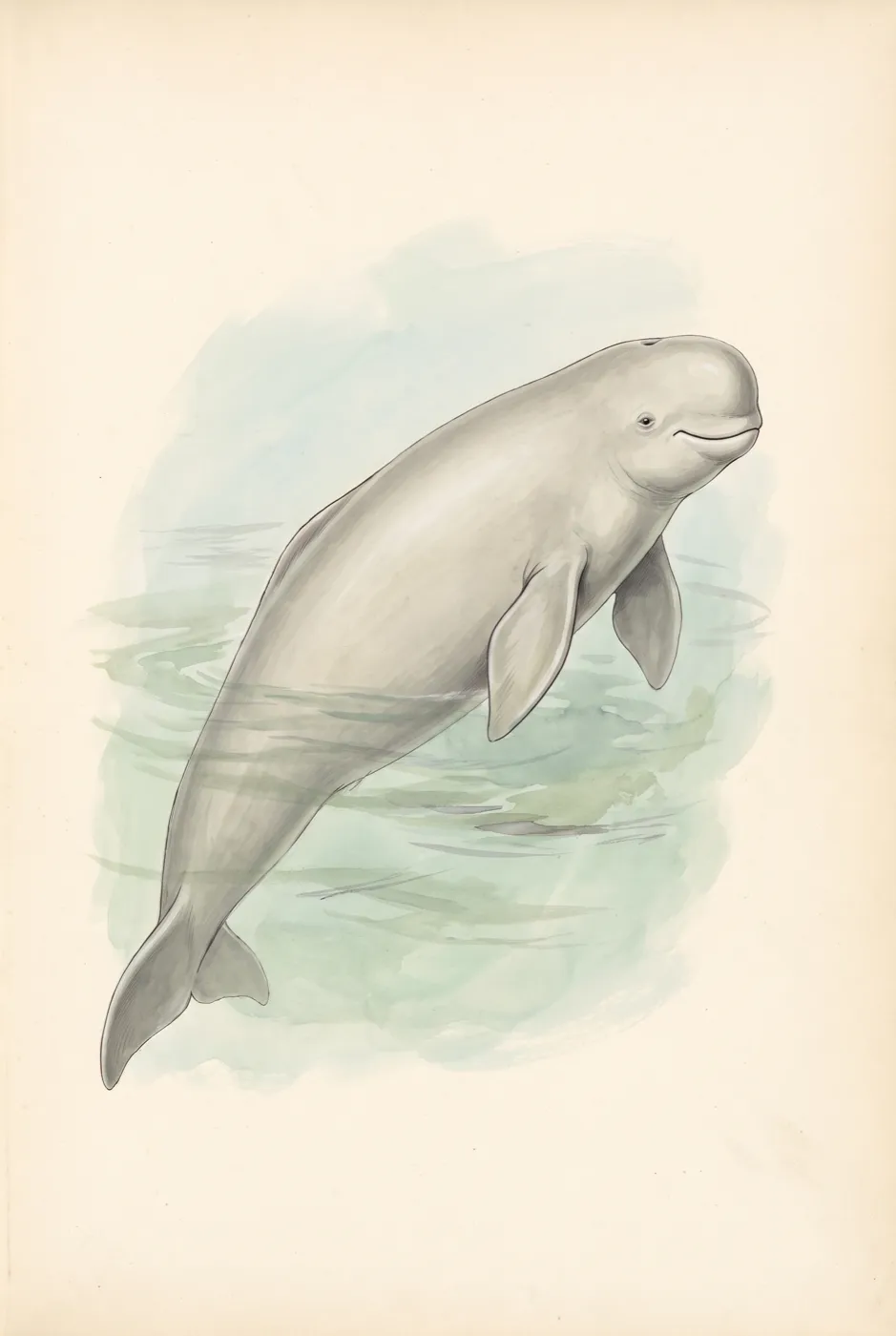
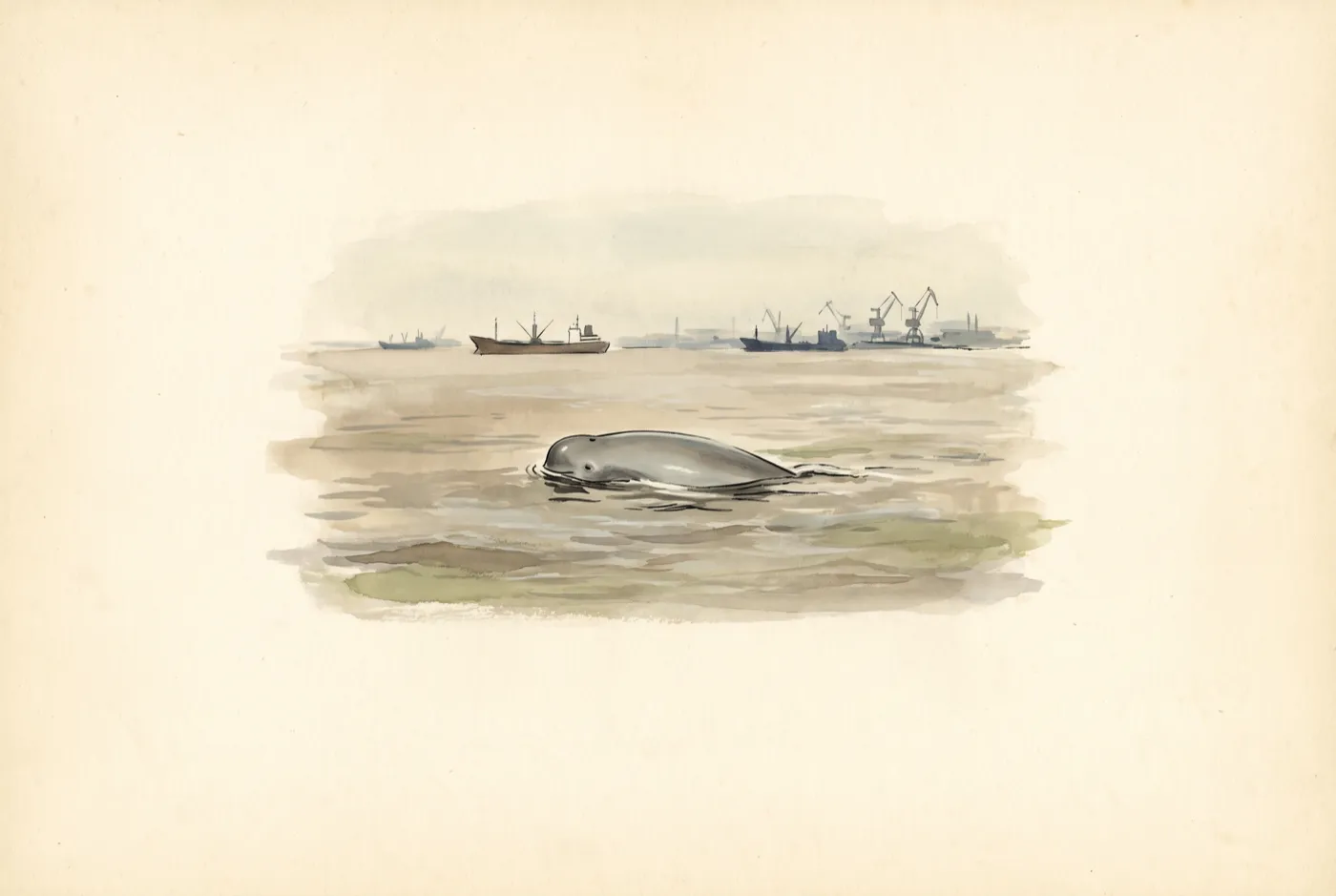
On 1 January 2021, China stopped productive fishing along the main stream and major tributaries of the Yangtze River for ten years — a whole river basin closed for a decade, with no obvious precedent. Five years in, the two animals most often named when the ban is discussed have moved in opposite directions. The Yangtze finless porpoise, which had declined for as long as anyone had counted it, rose from 1,249 animals in 2022 to 1,426 in 2025. The Chinese sturgeon, which spawns below a dam completed in 1981, has not turned around at all. The difference is not effort. It is which pressure a fishing ban reaches.
What the river had already lost
The baiji, the Yangtze river dolphin, was last seen in 2002 and declared functionally extinct in 2007, on the strength of a six-week survey by teams from seven countries. Wang Ding, of the Chinese Academy of Sciences, has said his research group was set up for the baiji back in 1978, when about 300 were thought to remain; reserves were gazetted and money was spent, and the number went down anyway.
The porpoise was on the same path. Roughly 2,700 in the early 1990s, about 1,800 by 2006, around 1,040 by a 2012 government survey, 1,012 in 2017. The IUCN moved it to Critically Endangered in 2013. What separates it from the baiji is mostly that the decision to act at river scale arrived while there were still enough animals for it to matter.
What a ten-year closure costs
The ban was not a signature on a document. By 2023, 111,000 fishing boats had been withdrawn and 231,000 fishers had left the trade. By the third quarter of 2025, 142,000 of them who wanted work had been placed in other industries and 220,000 were enrolled in pension insurance. Fifteen provinces and provincial-level cities are involved, coordinated by the Ministry of Agriculture and Rural Affairs.
It had been proposed long before. The academician Cao Wenxuan and sixteen colleagues put a ten-year ban forward in 2008 and were, in National Science Review's account, questioned and then ignored for years.
Why one animal and not the other
Ping Zhuang, of the East China Sea Fisheries Research Institute, put the asymmetry plainly: the porpoise was endangered mainly by a food shortage overfishing had caused, so it is the direct beneficiary of a fishing ban. The sturgeon is endangered mainly by habitat destruction — its spawning grounds lost to hydropower — which a fishing ban cannot touch.
The sturgeon's own record is worse than the summary suggests. NOAA Fisheries puts the adult population at 32,260 before 1981, 6,000 by 2010 and 2,569 by 2015, and records that the species failed to breed naturally in 2013, 2015, 2017, 2018 and possibly 2019. Hatchery-reared juveniles keep going into the river in their hundreds of thousands each year, which keeps the species present without making it self-sustaining.
What the protected area is doing
Alongside the ban there is a network of places. Writing in October 2025, the Chinese Academy of Sciences counted eight in-situ reserves on the main stream and in Dongting and Poyang lakes, covering more than 30 percent of the river's middle and lower reaches, and four ex-situ reserves in quiet oxbow lakes holding over 150 porpoises between them, with roughly ten calves born a year. One of them, the Tian'ezhou oxbow in Hubei, is a national nature reserve for the baiji. It was set aside for an animal that did not make it, and it is breeding the one that did.
That is the argument for protecting whole systems rather than single species, and also its limit. A closed river gave the porpoise its food back. It did not give the sturgeon its spawning ground back, and nobody involved claims it will. Qiwei Wei, who has worked on the sturgeon for decades, says the recovery will be long and will need the spawning grounds rebuilt; Zhuang says it will require giving up some of what the dams provide.
National Science Review's interviews with the researchers running the monitoring — Chen, Wei, Zhuang, Gui — are the clearest account of what the first five years measured, and they are free to read. Our record for the Yangtze finless porpoise holds the animal itself.
Sources
Read the same pages this note was written from. A citation is not a partnership or an endorsement.
Witness keeps one species a week: a drawn plate, its true story with sources, and one honest action. The archive is open to read, and these notes are the reading around it.