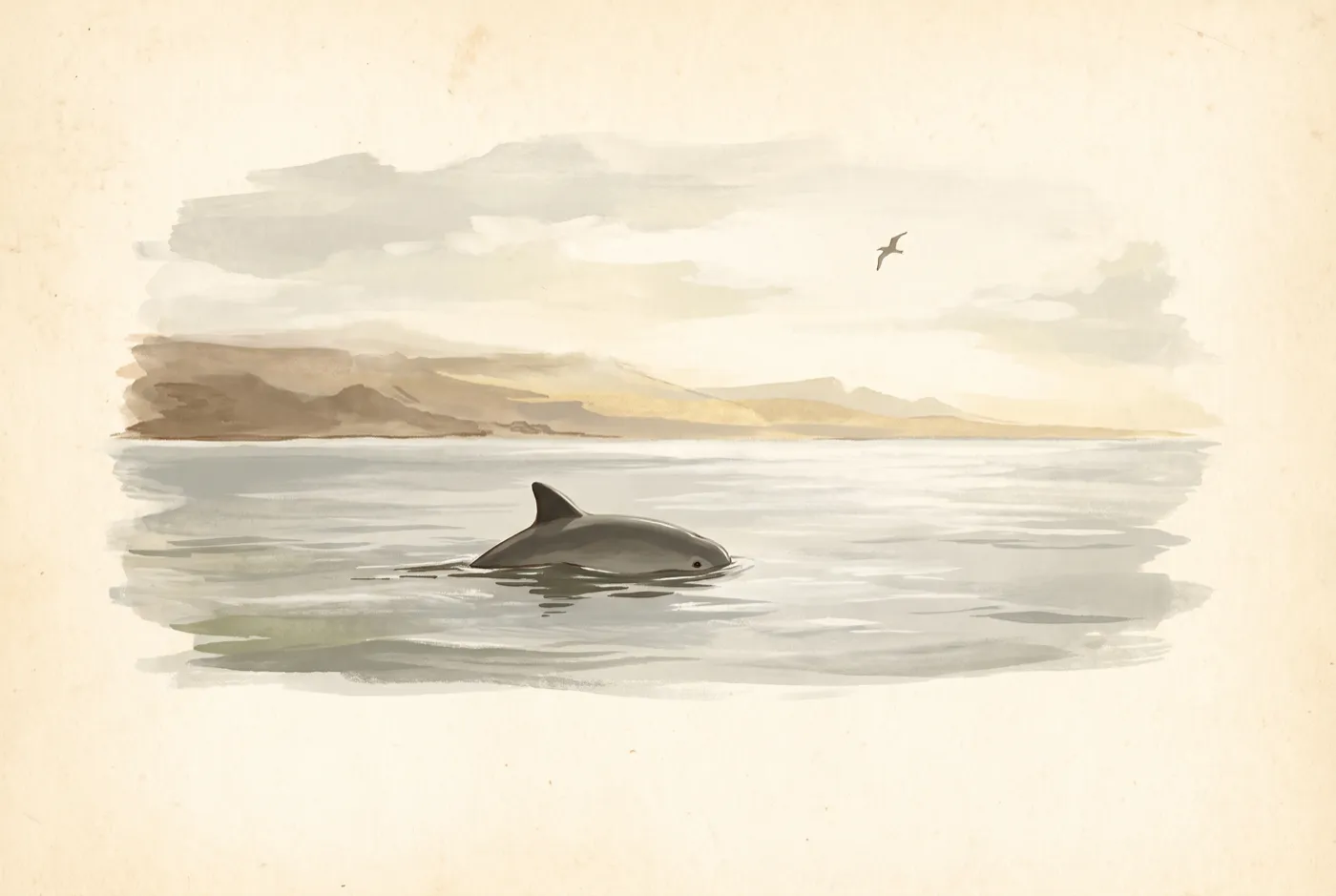
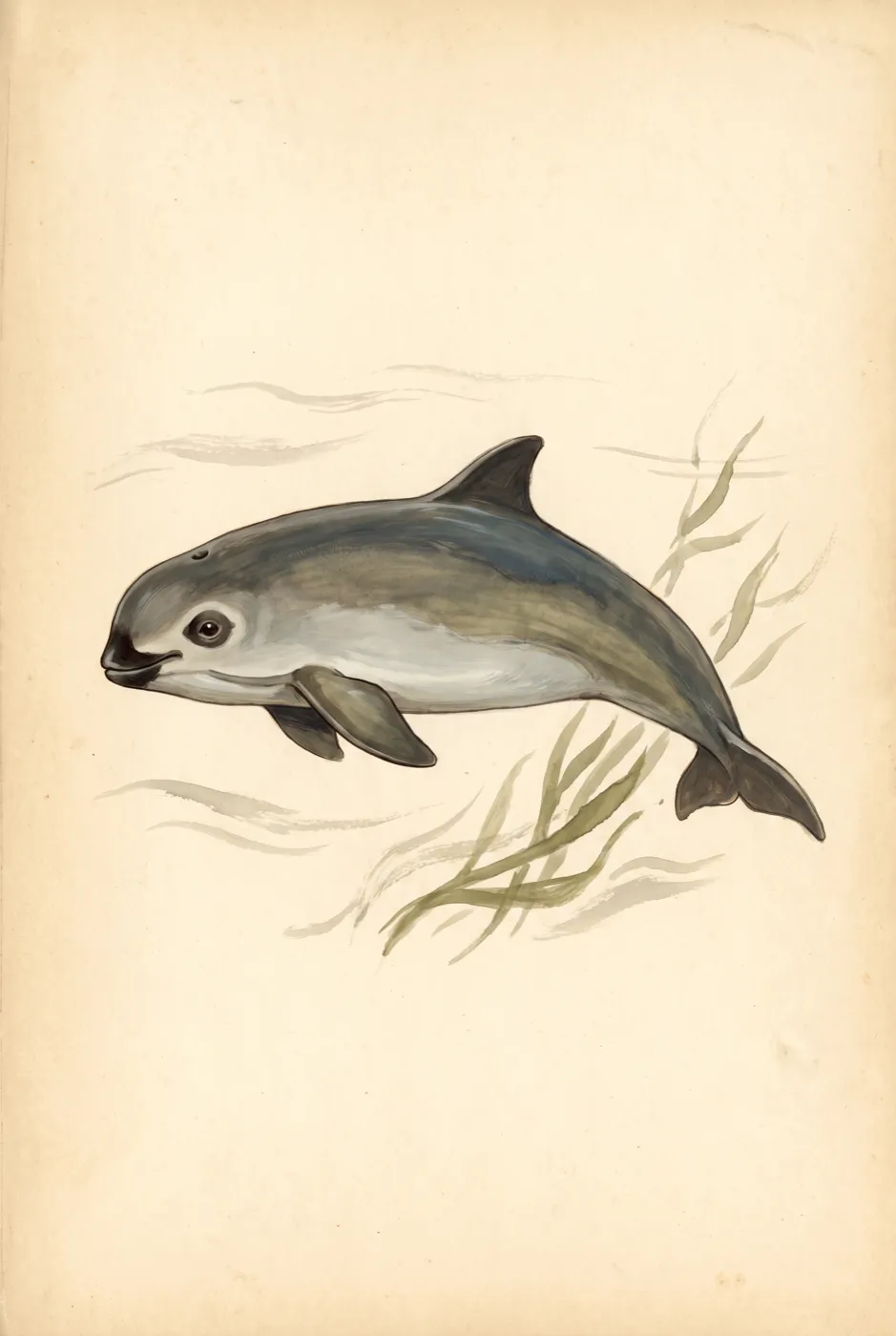
The most recent published survey of the vaquita, carried out in the northern Gulf of California between May and September 2025, recorded between seven and ten individuals, with roughly two-in-three confidence in that range, and at least one and possibly two calves. That figure counts animals the observers could see and identify. It is not a full population estimate: the last complete abundance estimate was made in 2015, and a new one drawn from the 2025 acoustic data had not been published as of this writing.
The number is a count of sightings, not a census
Two ships worked the northern Gulf through September 2025, each carrying three pairs of 25x binoculars and a rota of experienced observers. Where they looked was decided by acoustic detectors moored through the summer, spaced between one and five kilometres apart, which register the clicks a vaquita makes to navigate and feed. Photographs and drone footage from every sighting were compared against a catalogue of known individuals, some of them identifiable by the shape of a dorsal fin.
The result is then produced by expert elicitation: the people who did the watching are asked, formally, how many distinct animals they believe they saw, and how confident they are. That method sounds soft next to a statistical abundance estimate, and it is used because the honest alternative does not exist. At these numbers, a conventional line-transect survey has almost nothing to work with. A range of seven to ten, held with about two-in-three confidence, is a more truthful object than a single number carrying a decimal point.
Why the pages you find disagree
NOAA's vaquita abundance page still closes on the figure it was written around: approximately 30 animals, as of November 2016. NOAA's own species directory, updated in March 2026, says fewer than 20 remain and that the species may now number as few as ten, and notes that the last full survey took place in 2015. Conservation organisations publish round numbers of their own.
None of those pages is dishonest. They are dated differently, they answer slightly different questions, and a search engine flattens all of them onto one screen. When a number matters, take the one whose source says when it was measured and what it measured — and treat any figure without those two things as a rumour with a citation attached.
What changed in 2025
The surveys of the three preceding years, run by the same teams and methods, give the only useful comparison. In 2023 the elicited range was eight to twelve. In 2024 it was six to eight, and the observations inside the protected area came in lower than expected — which is why the 2025 effort was widened to cover water the earlier surveys had not searched. In 2025 the range was seven to ten, with at least one calf, one of them belonging to a female known as Frida, recognisable by a bent dorsal fin, who has now raised calves in three consecutive years.
The 2025 report is careful about what this does and does not show. There was no decline of the magnitude recorded in the worst years, when the population fell by nearly half in a single year in both 2017 and 2018. Vaquitas are still reproducing, and some calves are surviving their first years. Most detections came from inside the small zone where enforcement is concentrated, and some came from water just outside it, which is the finding with a consequence attached.
What the number cannot tell you
Nothing in the 2025 result changes the cause. Vaquitas drown in gillnets, particularly those set illegally for totoaba, and the International Union for Conservation of Nature has listed the species as Critically Endangered since 1996; it is listed as endangered under the United States Endangered Species Act. A count that holds steady across two years is not a recovery. It is the absence of another collapse, measured with wide uncertainty, in a population small enough that one bad season would take back everything the last three added.
The next real datum is the abundance estimate still to come from the 2025 acoustic work. Until then, the honest answer to the question in the title is a range, a date, and a method — which is also the whole record we keep for this species.
Sources
Read the same pages this note was written from. A citation is not a partnership or an endorsement.
- seashepherd.org · https://seashepherd.org/2025/10/28/results-of-the-2025-vaquita-monitoring-effort/
- iucn-csg.org · https://iucn-csg.org/joint-visual-and-acoustic-survey-finds-vaquitas-surviving-and-reproducing-mostly-in-and-near-the-sanctuary/
- fisheries.noaa.gov · https://www.fisheries.noaa.gov/west-coast/science-data/vaquita-conservation-and-abundance
- fisheries.noaa.gov · https://www.fisheries.noaa.gov/species/vaquita
- iucn-csg.org · https://iucn-csg.org/vaquita/
The reading around the record, delivered.
The email edition is being set up. Until then, the feed carries every note the day it ships.
More in Species
View all →