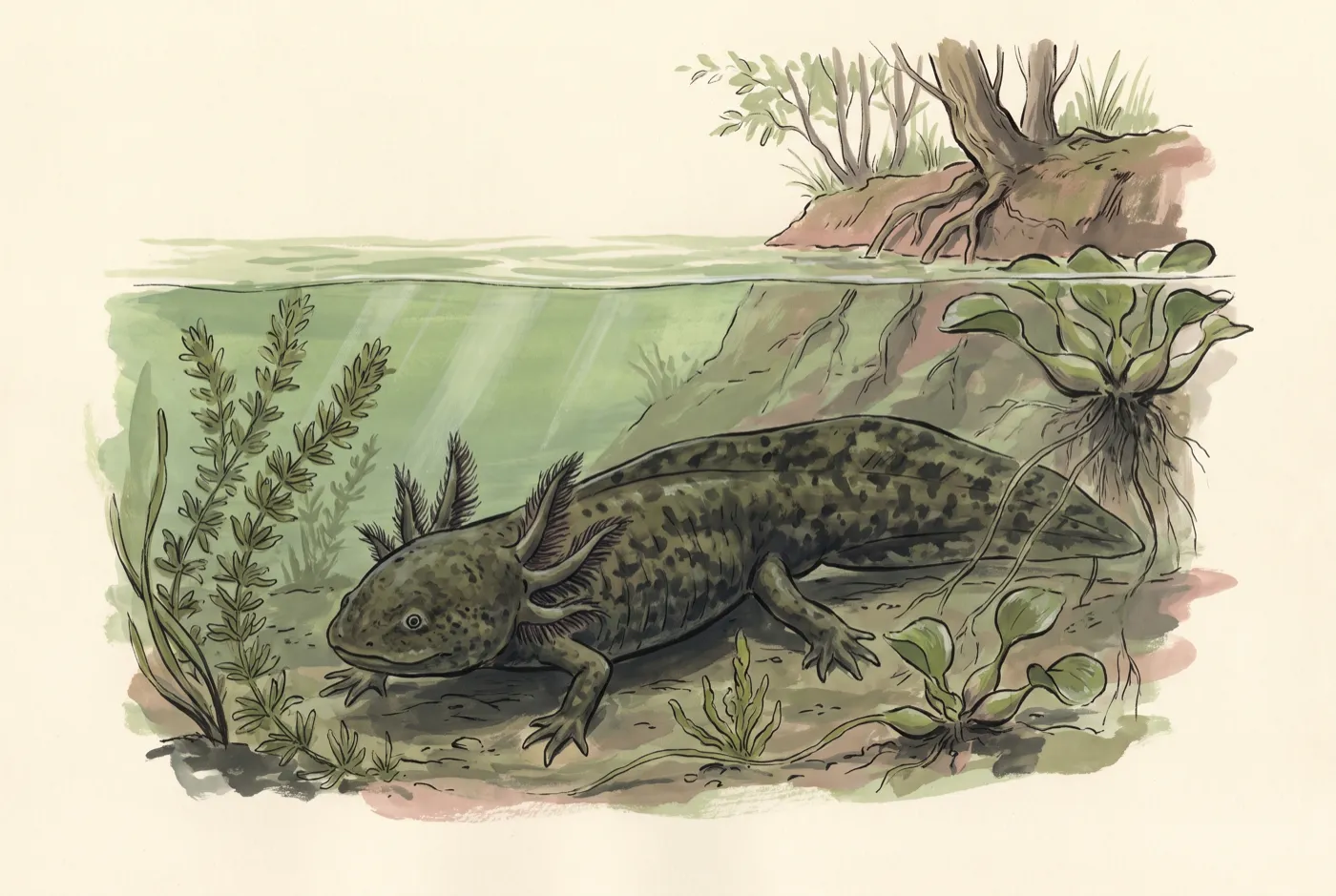
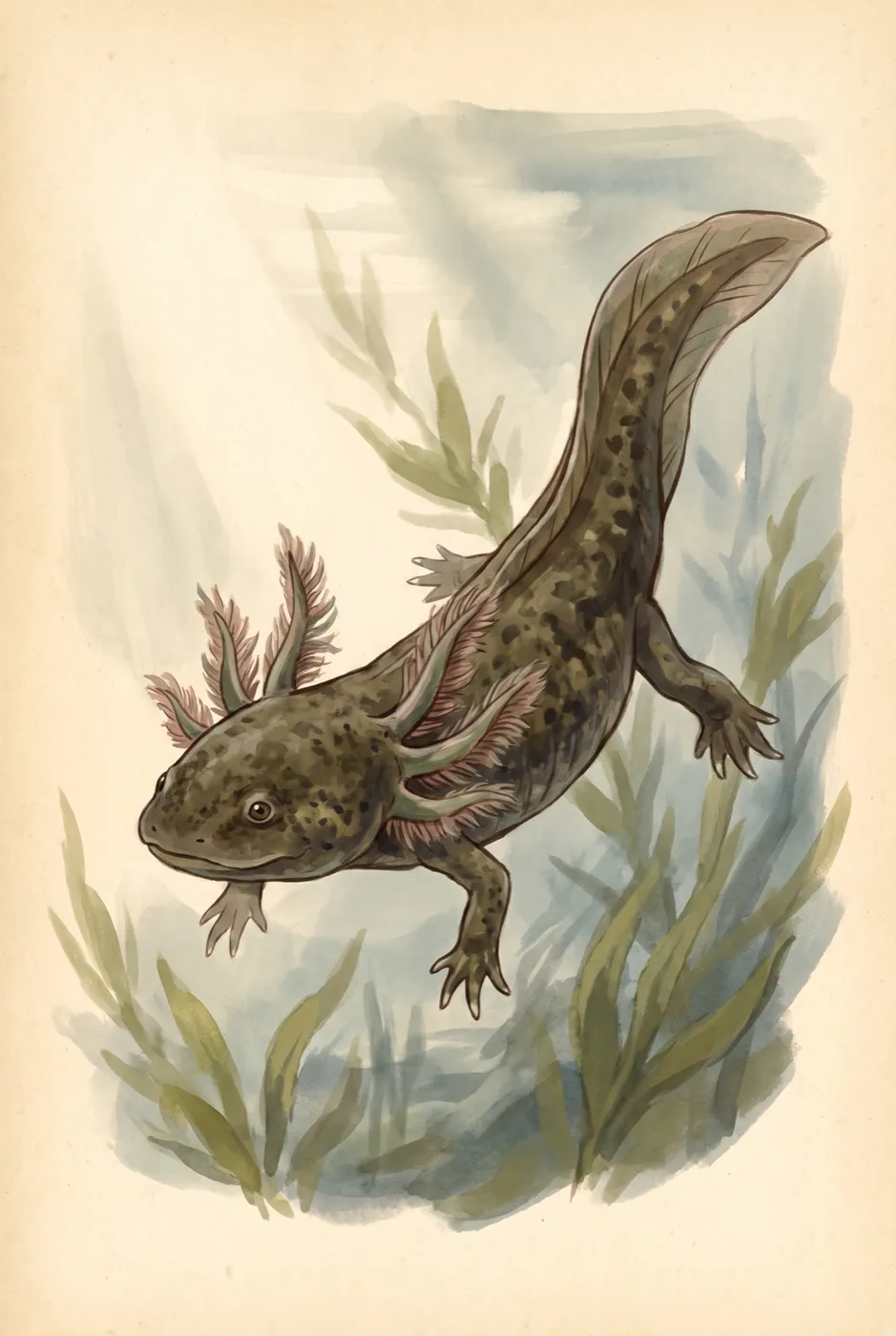
No. Extinct in the Wild is a specific category on the IUCN Red List, with a written test attached, and the axolotl does not meet it. Ambystoma mexicanum is listed as Critically Endangered, the category below it, and was most recently assessed in 2019. The question is a reasonable one to ask, though. In a survey of the canals of Xochimilco in southern Mexico City reported in August 2025, the nets came up empty. What the researchers found instead was the animal's genetic material, loose in the water.
The category is narrower than the phrase
The Red List's categories are defined in a document anyone can download, and Extinct in the Wild has two parts. A taxon qualifies when it "is known only to survive in cultivation, in captivity or as a naturalized population (or populations) well outside the past range." It is presumed Extinct in the Wild when "exhaustive surveys in known and/or expected habitat, at appropriate times (diurnal, seasonal, annual), throughout its historic range have failed to record an individual."
Both halves matter here. Axolotls are still recorded in Xochimilco, so the first half fails. And a survey that detects an animal without catching one has recorded it, so the second half fails too. The category is not a description of how bad things are. It is a claim about evidence, and the evidence still points the other way.
What the counts counted
The numbers that get repeated about the axolotl are densities, not totals — how many animals per square kilometre of canal, which is what you can actually measure in a waterway you cannot drain. Writing in BioScience in 2015, Voss, Woodcock and Zambrano put the decline like this: "The density of axolotls decreased from 6000 per square kilometer in 1998 to 100 in 2008," and added that "recent data suggests that there are fewer than 35 axolotls per square kilometer."
The last full count was made in 2014, and Conservation International, which supports the monitoring, puts that year's result at 36 per square kilometre. The two published figures differ by roughly one animal per square kilometre, which is worth noticing only because it shows how little is left to round. The 2019 Red List assessment put the surviving wild population somewhere between 50 and 1,000. A range that wide is not evasion. It is what an honest estimate looks like when the thing being estimated has become hard to find.
The survey that caught nothing
The most recent effort, run by the Ecological Restoration Laboratory of the Universidad Nacional Autónoma de México with support from Conservation International-Mexico, worked 115 monitoring sites across the 2,500 hectares of the Xochimilco protected area. For the first time it used environmental DNA alongside nets: water is collected and searched in a laboratory for the cells and traces an animal sheds as it passes.
No axolotl was netted. The eDNA found them anyway, in the less disturbed water and in several of the chinampa refuges — restored versions of the raised farming plots that have worked this wetland since before the city grew over it. "Unlike previous surveys, this time we included environmental DNA to better understand where axolotls are surviving and how their habitat is changing," Luis Zambrano, who directs the laboratory, told Conservation International. Twenty-one of those chinampa refuges are now running, with biofilters to clean the water.
The other axolotl
The reason the question gets asked at all is that axolotls are simultaneously common. Nearly every one in a laboratory tank or a pet shop descends from a small shipment out of this same lake system: 34 animals that reached Paris in 1863, of which, the BioScience authors write, "From just five males and one female, the Jardin des Plantes distributed thousands of axolotls to scientists throughout Europe." The domesticated line was founded on six animals and has been bred continuously ever since. It has no bearing on the wild population, which is why the Red List counts them separately.
What is actually being tried
In April 2025, Ramos, Mena, Schneider and Zambrano published the first real test of putting captive-bred axolotls back. They released small groups — eight animals into a constructed pond in a university reserve in 2017, five pairs into a restored chinampa in 2018 — and tracked them by radio tag. The animals survived the tracking period and foraged. Two that were recaptured had put on weight, one of them by more than 18 grams. Movement peaked at water temperatures of around 16 to 17 degrees, which the authors read as a narrow thermal preference. After the study ended, a great egret took one of them, and local farmers reported a second.
That is the state of the evidence: an animal that is hard to find, not one that is gone, and a small number of people testing whether the water can be made to hold it again. The release paper is open access, and the record we keep for the species links the reading behind it. If the category itself is the confusing part, what critically endangered actually means is the longer answer.
Sources
Read the same pages this note was written from. A citation is not a partnership or an endorsement.
- journals.plos.org · https://journals.plos.org/plosone/article?id=10.1371/journal.pone.0314257
- academic.oup.com · https://academic.oup.com/bioscience/article/65/12/1134/223981
- conservation.org · https://www.conservation.org/news/axolotls-are-on-the-brink-can-we-bring-them-back
- portals.iucn.org · https://portals.iucn.org/library/sites/library/files/documents/RL-2001-001-2nd.pdf
- dx.doi.org · https://dx.doi.org/10.2305/IUCN.UK.2020-3.RLTS.T1095A53947343.en
- mexiconewsdaily.com · https://mexiconewsdaily.com/news/axolotl-disappear-xochimilco-canals-2025/
Free to read
Reading is where it starts.
Witness keeps one species a week: a drawn plate, its true story with sources, and one honest action. The archive is open to read, and these notes are the reading around it.
More in Numbers
View all →